
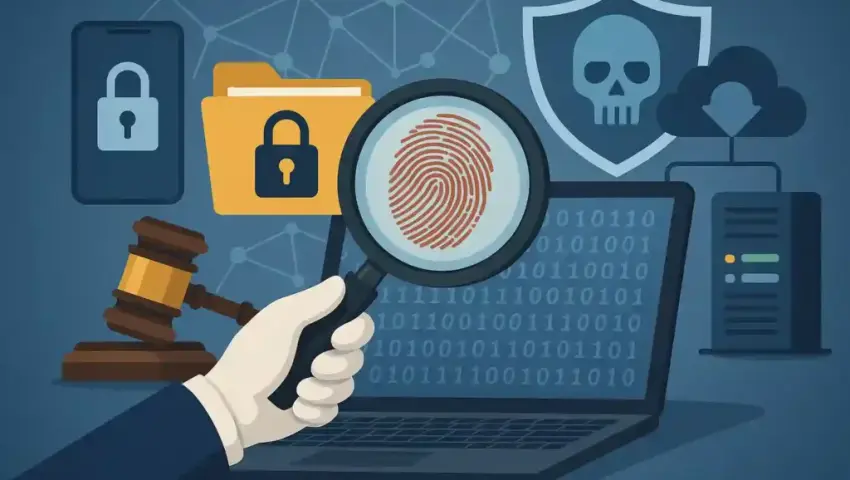
Inside Cyber Forensics Labs: Tools Used by Elite Agencies to Solve Crimes
-
 By Mrityunjay Singh
 - BLOGS
- Mar 20, 2026
- 3 minutes read
- 128 Views
In today’s digital age, solving crimes is no longer limited to fingerprints and physical evidence. Most modern investigations rely on digital evidence — data stored in computers, smartphones, and online platforms.
This is where cyber forensics labs come into play. These are specialized environments where experts analyze digital devices to uncover hidden evidence. Agencies like the CBI , CIA , and Mossad depend heavily on such labs to solve complex cases.
In this article, we’ll take a closer look inside these labs and explore the tools and techniques used by experts.
🧪 What Is a Cyber Forensics Lab?
A cyber forensics lab is a controlled and secure environment where digital evidence is examined in a legal and scientific manner.
These labs are designed to:
- prevent data tampering
- maintain evidence integrity
- ensure results are acceptable in court
Experts working here follow strict procedures to make sure every piece of evidence is handled properly.
👉 Even a small mistake can make evidence invalid, so accuracy is critical.
🔍 How a Cyber Forensic Investigation Works
Before looking at the tools, it’s important to understand the process followed in most investigations.
1. Evidence Collection
Devices like laptops, hard drives, and smartphones are collected carefully without altering data.
2. Data Imaging
A complete copy (image) of the device is created so the original data remains untouched.
3. Analysis
Experts analyze the copied data using forensic tools to find relevant information.
4. Reporting
A detailed report is prepared, which can be presented in court as evidence.
👉 This step-by-step process ensures the investigation is both accurate and legally valid.
💻 1. FTK (Forensic Toolkit) – Deep Data Analysis


FTK is one of the most widely used digital forensic tools. It helps investigators scan and analyze large volumes of data quickly.
With FTK, experts can:
- search for keywords across files
- recover deleted data
- analyze emails and documents
👉 It is especially useful when dealing with large datasets in cybercrime cases.
💾 2. EnCase – Industry Standard Forensics Tool


EnCase is considered one of the most trusted computer forensics tools used worldwide.
It allows investigators to:
- recover deleted files
- examine disk images
- track user activity
Because of its reliability, EnCase is often used in legal cases where strong digital evidence is required.
🧩 3. Autopsy – Open Source Forensic Platform


Autopsy is a powerful open-source digital forensics tool that is widely used by investigators and even students.
It helps in:
- file system analysis
- timeline creation
- detecting suspicious activity
👉 Despite being free, it offers many advanced features useful in investigations.
⚙️ 4. X-Ways Forensics – Fast & Efficient Analysis


X-Ways Forensics is known for its speed and efficiency. It is often preferred by professionals who need quick results.
It allows:
- disk cloning and imaging
- file recovery
- detailed analysis of storage devices
👉 Its lightweight design makes it faster compared to many other tools.
🧠 Why These Tools Are So Important
Cyber forensic tools are essential because they help uncover evidence that is not visible to the naked eye.
For example:
- a deleted file can be recovered
- hidden data can be revealed
- user actions can be reconstructed
👉 This makes it possible to rebuild the entire sequence of events in a crime.
⚠️ Legal Importance of Digital Evidence
One of the most critical aspects of cyber forensics is legality.
- Evidence must be collected properly
- Tools must be reliable and verifiable
- Reports must be clear and detailed
If any step is done incorrectly, the evidence may not be accepted in court.
👉 That’s why cyber forensics labs follow strict international standards.
🏁 Conclusion
Cyber forensics labs are the backbone of modern investigations. They combine technology, expertise, and legal procedures to uncover the truth hidden inside digital devices.
With the help of tools like FTK, EnCase, Autopsy, and X-Ways, agencies like CBI, CIA, and Mossad can solve even the most complex cybercrime cases.
👉 In today’s world, digital evidence often speaks louder than eyewitnesses.
Mrityunjay Singh
Leave a comment
Your email address will not be published. Required fields are marked *